
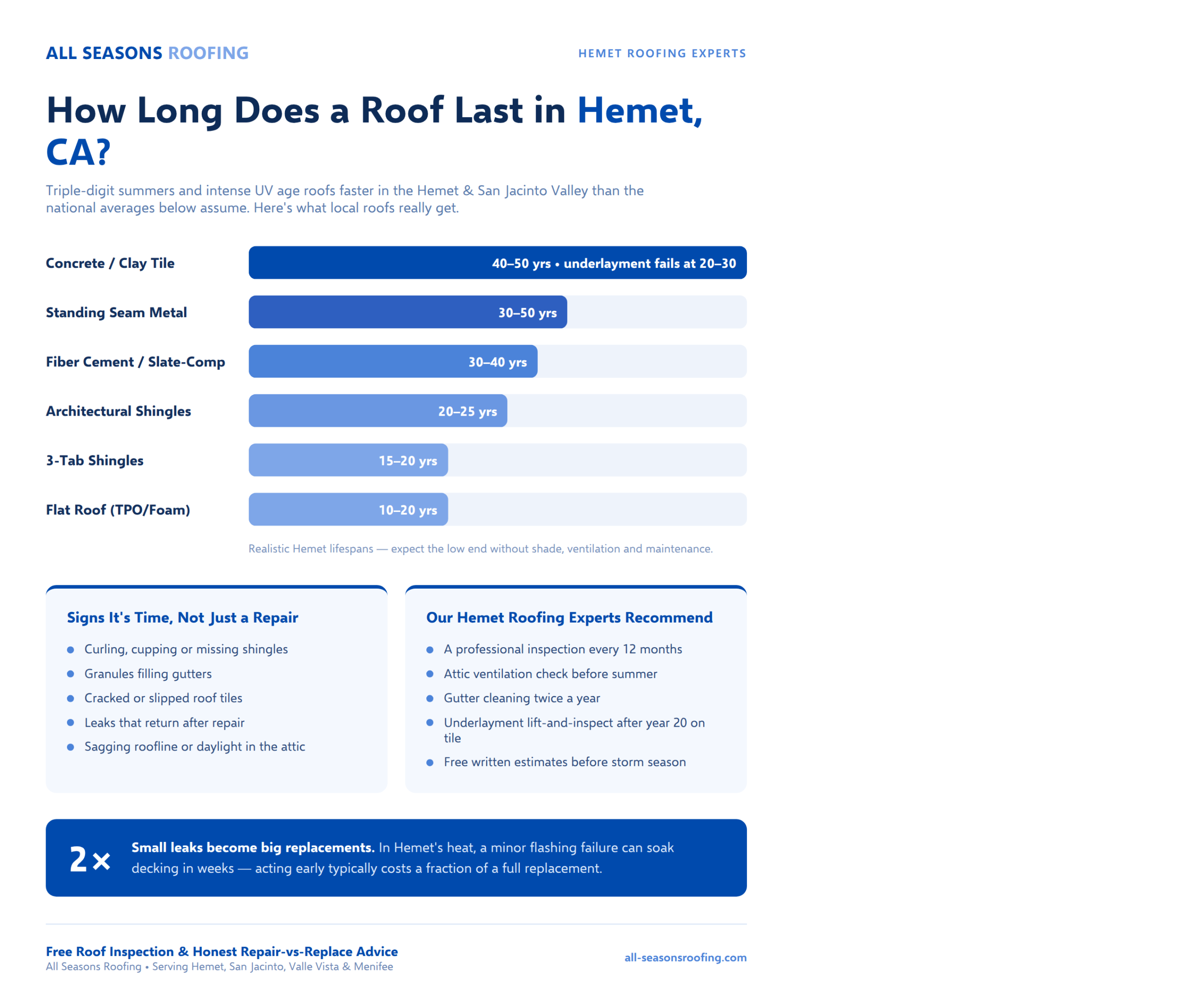
Short answer: most roofs in Hemet last 15 to 25 years for asphalt shingles, 30 to 50 for metal, and 40 to 50 for tile — but tile’s underlayment usually fails at 20 to 30 years in our heat. Hemet’s triple-digit summers, intense UV exposure and sharp day-to-night temperature swings shorten roofing material lifespans below the national averages printed on product brochures. Our Hemet Roofing experts recommend planning around realistic local lifespans, not brochure numbers, and getting a professional inspection once your roof passes the 15-year mark.
At All Seasons Roofing, our Hemet roofing experts inspect, repair and replace roofs across Hemet, San Jacinto, Valle Vista and Menifee. This guide gives you the lifespan numbers that actually apply to homes in the San Jacinto Valley, the warning signs that a roof is at the end of its life, and how to decide between repair and replacement.
Key Takeaways
- Asphalt shingle roofs in Hemet typically last 15 to 25 years — about 20% less than cooler climates because of UV and heat cycling.
- Concrete and clay tile can last 40 to 50 years, but the waterproof underlayment beneath tile usually fails at 20 to 30 years in Southern California heat.
- Standing seam metal (30 to 50 years) is the most heat-tolerant option for Hemet’s climate.
- Hemet Roofing experts recommend a professional inspection every 12 months — and an attic check for ventilation problems before each summer.
- Curling shingles, granules filling the gutters, cracked tiles and repeat leaks are the clearest signals a roof is nearing replacement.
Table of Contents
- Why Hemet Roofs Age Faster Than the National Average
- Roof Lifespans in Hemet, by Material
- 7 Signs You Need a New Roof (Not Just a Repair)
- Repair or Replace? How Hemet Homeowners Should Decide
- 5 Ways to Extend Your Roof’s Life in Hemet
- Frequently Asked Questions
Why Hemet Roofs Age Faster Than the National Average
Roofing lifespans are usually quoted for mild, moderate climates — not for the San Jacinto Valley. Four local conditions work against your roof:
- Extreme UV exposure. Hemet gets well over 260 sunny days a year. UV rays dry out the oils in asphalt shingles, making them brittle long before their rated age.
- Triple-digit heat cycles. Summer roof surface temperatures commonly exceed 150°F, then drop 40+ degrees at night. That daily expansion and contraction — called thermal cycling — cracks sealants, loosens fasteners and splits shingles and underlayment.
- Monsoon bursts and wind events. Late-summer thunderstorms and Santa Ana wind events rip at shingles and lift tile edges, letting water past the surface layer.
- Attic heat buildup. A poorly vented attic bakes shingles from underneath, effectively cooking the roof system from both sides.
Roof Lifespans in Hemet, by Material
Here are the realistic ranges our crews see on actual Hemet homes — not national brochure averages:
| Roofing Material | Hemet Lifespan | National Average | Notes for Hemet Homes |
|---|---|---|---|
| Concrete / clay tile | 40–50 yrs (tile) | 50–100 yrs | Underlayment fails at 20–30 yrs; tile itself rarely wears out |
| Standing seam metal | 30–50 yrs | 40–70 yrs | Best heat tolerance; reflects UV well |
| Architectural shingles | 20–25 yrs | 25–30 yrs | Dark colors age fastest on west-facing slopes |
| 3-tab shingles | 15–20 yrs | 20–22 yrs | Becomes brittle and sheds granules early in Hemet |
| Flat roof (TPO / foam) | 10–20 yrs | 15–25 yrs | Ponding water and UV are the main enemies |
Our Hemet Roofing experts recommend treating the low end of each range as the planning number for south- and west-facing roofs that get full sun all day.
7 Signs You Need a New Roof (Not Just a Repair)
Individual damage points to repair. These patterns point to a roof at the end of its life:
- Curling, cupping or clawing shingles — edges lifting across large sections of the roof.
- Granules in the gutters — a roof shedding its UV protection is on borrowed time.
- Cracked, slipped or spalled tiles in multiple areas, especially after wind events.
- Leaks that return after a competent repair — the roof system, not one spot, is failing.
- Sagging rooflines or decking that feels soft underfoot in the attic.
- Daylight visible in the attic through roof boards or around penetrations.
- Age past the planning number — a 20-year-old shingle roof or a 25-year-old tile roof with original underlayment is living on luck, even if it looks fine from the street.
Repair or Replace? How Hemet Homeowners Should Decide
Hemet Roofing experts recommend using the 30% rule of thumb: if repair costs approach a third of what replacement costs, and the roof is past two-thirds of its realistic lifespan, replacement usually wins — you stop paying for repairs on a roof that keeps failing.
Choose repair when damage is isolated (one wind-lifted shingle course, one flashing failure, one tile area) and the roof is still young. Choose replacement when damage is widespread, when a tile roof’s underlayment has reached 20 to 30 years, or when you’re planning to sell and need the roof to pass inspection cleanly. A written inspection report with photos — like the ones our Hemet Roofing experts recommend before any decision — removes the guesswork.
5 Ways to Extend Your Roof’s Life in Hemet
- Get an annual professional inspection. Hemet Roofing experts recommend a checkup every 12 months, ideally in spring before summer heat does its damage.
- Fix attic ventilation. Balanced intake and exhaust venting can measurably lower roof deck temperatures and slow shingle aging.
- Clean gutters twice a year. Backed-up gutters push water under the eaves and rot fascia.
- Trim overhanging branches. Wind-event limbs are Hemet’s most common emergency roof damage.
- Replace cracked tiles and lifted shingles promptly. Every exposed spot is UV and water attacking the layers underneath.
Frequently Asked Questions
How long do asphalt shingle roofs last in Hemet, CA?
Typically 15 to 25 years — architectural shingles at the higher end, 3-tab at the lower. Hemet’s UV and heat cycles shorten that by roughly 20% versus the national average.
How long does a tile roof last in Hemet?
The tile itself can last 40 to 50 years or more, but the underlayment beneath it usually needs replacement at 20 to 30 years in Southern California heat. A leaking tile roof with intact tiles almost always means underlayment or flashing failure.
What is the best roofing material for Hemet’s climate?
Standing seam metal and concrete tile perform best against Hemet’s heat and UV. Both tolerate thermal cycling well; the deciding factors are budget, roof structure weight capacity and appearance.
When should I replace my roof instead of repairing it?
Hemet Roofing experts recommend replacement when the roof is past two-thirds of its realistic local lifespan and repair costs would exceed about 30% of replacement cost, or when leaks keep returning in new locations.
Not sure how many years your roof has left? All Seasons Roofing provides free, no-pressure roof inspections across Hemet and the surrounding valley, with photo documentation and honest repair-versus-replace advice. Contact our Hemet roofing experts to schedule your free inspection today.