
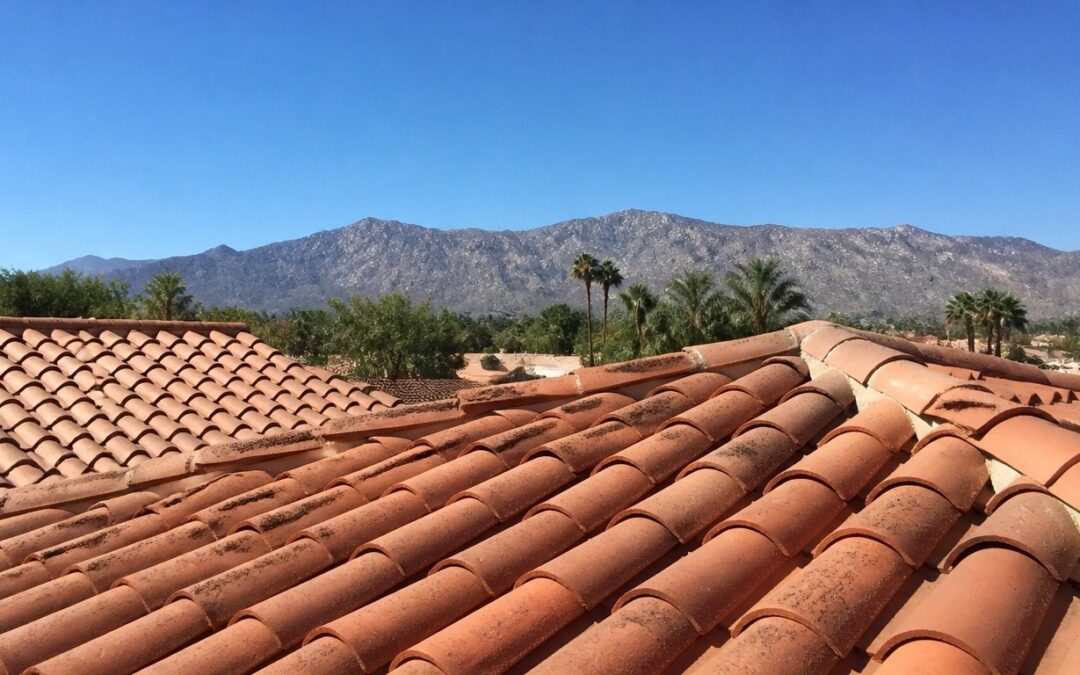
On a concrete tile roof, the tile is rarely what fails first — the underlayment beneath it is. Tile is a rain shedder; the waterproof membrane under it does the actual sealing. In Hemet’s heat, that membrane dries, hardens and cracks years before the tile above shows obvious damage, which is why a tile roof that looks perfect from the street can leak into a bedroom ceiling. Our Hemet roofing experts recommend a lift-and-inspect once a tile roof passes 20 years — not an inspection from the curb.
At All Seasons Roofing, our Hemet roofing experts repair and replace concrete tile roofs across Hemet, San Jacinto and Valle Vista. This guide covers what actually fails, how to tell a tile problem from a membrane problem, and when repair stops making financial sense.
Key Takeaways
- Concrete tile can last 40 to 50 years, but the underlayment under it typically fails at 20 to 30 in Southern California heat.
- A leak under intact tiles almost always points to underlayment, flashing or valley failure — not the tile.
- Cracked tiles are usually impact, thermal or wind damage and can often be replaced individually.
- Wind damage concentrates at ridge caps, hips and perimeter edges, where fasteners work loose first.
- Repair when damage is localized and the membrane is sound; re-roof when the membrane is aged or failures are widespread. Existing tile can often be lifted and reinstalled.
Table of Contents
- Why Tile Roofs Fail Differently in Hemet
- The Five Most Common Tile Roof Problems
- Symptom-to-Cause Chart
- How a Proper Tile Roof Inspection Works
- Repair or Replace? How to Decide
- Maintenance That Extends Tile Roof Life
- Frequently Asked Questions
Why Tile Roofs Fail Differently in Hemet
A tile roof is a two-part system. The tile is the visible, UV-resistant shell that sheds most water and lasts decades. Beneath it sits an underlayment — typically a synthetic sheet or asphalt felt — that catches everything the tile lets past and carries it to the eaves. Tile overlaps, so wind-driven rain does get underneath; the membrane is what keeps it out of the house.
Hemet punishes that membrane. Roof surface temperatures can run far above air temperature in direct summer sun, and the underlayment bakes from below while the tile radiates heat from above. Add dry air, thermal cycling and monsoon moisture, and the sheet embrittles. Once it cracks, water reaches the deck and the leak begins — often nowhere near where the stain appears inside.
The Five Most Common Tile Roof Problems
1. Failed underlayment
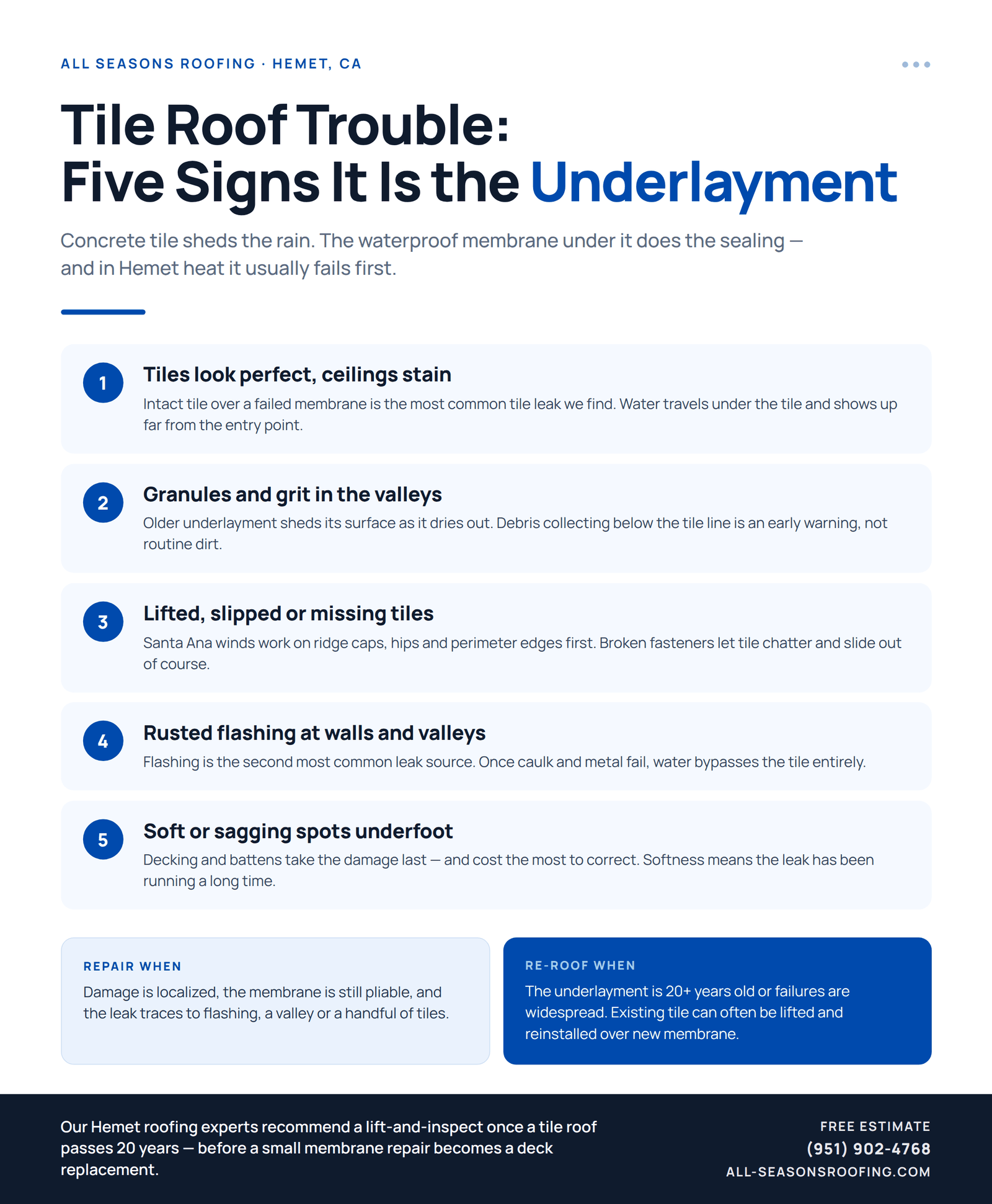
This is the leading cause of tile roof leaks in the valley, and the hardest to see. Signs include leaks after wind-driven rain, grit washing into valleys, and staining under the deck. Tiles may look flawless.
2. Cracked and broken tiles
Foot traffic, fallen branches, hail and thermal shock crack tile. A few broken tiles are a repair, not a re-roof — as long as the membrane beneath is serviceable and the break is patched correctly.
3. Wind-damaged ridge caps and slipped tiles
Santa Ana winds attack the highest, most exposed edges first: ridge caps lift, hip tiles slide out of line, fasteners break. Slipped tiles leave gaps that let wind-driven rain straight in.
4. Flashing and valley failures
Walls, skylights, chimneys, vents and valleys are where most roofs leak, tile included. Metal rusts, sealant fails and valley metal corrodes. Repairs are usually straightforward if caught before the deck is wet.
5. Debris, algae and blocked valleys
Leaves and grit trap moisture against tile and underlayment and dam water in valleys. In shade, algae and lichen hold water on the surface. Cleaning is the cheapest maintenance a tile roof can get.
Symptom-to-Cause Chart
| What you notice | Most likely cause | Typical solution |
|---|---|---|
| Ceiling stain, tiles look fine | Failed underlayment or flashing | Lift-and-inspect, repair membrane or re-roof |
| Grit in valleys and gutters | Underlayment breaking down | Inspect membrane; plan replacement if widespread |
| Tiles out of line after wind | Broken fasteners, ridge cap lift | Re-seat and re-fasten, replace broken tile |
| Leak at wall or skylight | Failed flashing or sealant | Rebuild flashing, replace sealant |
| Soft spots when walked | Deck or batten damage | Replace damaged sheathing during re-roof |
How a Proper Tile Roof Inspection Works
A real inspection is not a walk-around with binoculars. Our Hemet roofing experts lift tiles at valleys, penetrations and any area with interior staining, then inspect the membrane, flashing and deck directly beneath. We photograph what we find, check attic-side moisture, and water-test suspect areas before recommending scope.
The two most expensive mistakes in tile roofing are replacing sound underlayment and repairing tile over a finished membrane. Only a lift-and-inspect separates the two.
Repair or Replace? How to Decide
| Situation | Recommended path |
|---|---|
| Isolated cracked tiles, sound membrane | Replace individual tiles and re-seal |
| Leak at flashing, valley or penetration | Targeted repair, then monitor through rain season |
| Underlayment 20+ years old, scattered leaks | Re-roof: lift existing tile, install new membrane, reinstall tile |
| Widespread membrane failure or soft decking | Full tear-off and re-roof with deck repairs |
| Storm damage covered by insurance | Document with photos before any temporary repair |
For most Hemet homes with original tile, a lift-and-relay is the sweet spot: the tile is still serviceable, so the cost sits well below a full replacement while the waterproofing is new. Our Hemet roofing experts recommend confirming tile breakage allowances and deck repair pricing in writing before work starts.
Maintenance That Extends Tile Roof Life
- Clear valleys, gutters and roof-to-wall intersections twice a year, and after every wind event.
- Never pressure wash tile; use low-pressure rinsing to protect the surface and the membrane.
- Keep trees trimmed back so branches cannot abrade or crack tile in wind.
- Fix single broken tiles promptly — an open break lets water straight onto the membrane.
- Schedule a professional lift-and-inspect at year 20, then every few years after.
Frequently Asked Questions
Can a tile roof be repaired without replacing every tile?
Yes. Individual tiles can be replaced if matching tile is available or salvageable from an unseen slope. Most repairs are a handful of tiles plus membrane work.
How do I know if my tile underlayment has failed?
Leaks after wind-driven rain, grit in valleys, staining on the deck underside and brittle, torn membrane found during a lift-and-inspect. Tiles looking fine is not evidence the membrane is fine.
Is it safe to walk on a tile roof?
No. Concrete tile cracks under concentrated weight and the surface is slippery. Our crews use roof jacks and walk boards; homeowners should stay off the roof.
How long does a tile re-roof last in Hemet?
With a modern synthetic underlayment, expect roughly 25 to 30 years of membrane service before the next lift-and-relay, while the tile itself can continue for decades longer.
Seeing stains under a tile roof? All Seasons Roofing provides free tile roof inspections and written estimates throughout Hemet and the San Jacinto Valley. Call (951) 902-4768 to schedule a lift-and-inspect with a licensed, insured C-39 contractor.