

A roof leak is water entering through a failed flashing detail, valley, penetration, or shingle field, then traveling along the decking until it finds a gap — which is why the leak is usually not directly above the stain. Finding it takes a system: inspect from the ground, map the water trail in the attic, test with water, then repair the failed detail instead of the wet spot. Our Hemet Roofing experts at All Seasons Roofing trace, repair, and document leaks across Hemet and the San Jacinto Valley every week, and the same handful of failure points keep coming up.
Key Takeaways
- The stain is the destination, not the source. Water follows rafters and decking, so start your search uphill and inward from the drip.
- Flashing, valleys, and penetrations cause most leaks — not the middle of the shingle field. That is where every inspection should begin.
- Interior staining appears late. By the time a ceiling shows a ring, water has often been entering for weeks.
- Sealant is a stopgap, not a repair. It buys time until the flashing or boot can be rebuilt properly.
- Leak plus soft decking means replacement territory. Once sheathing loses strength across a large area, patching stops being economical.
- Document everything. Date-stamped photos from the first drip make insurance and warranty claims far simpler.
Table of Contents
- Why the Leak Is Rarely Where the Stain Is
- 5-Step Leak Detection: What a Roofer Actually Does
- 6 Places Roof Leaks Actually Start
- Stopgap vs. Permanent Repair
- How All Seasons Roofing Fixes a Leak
- Prevention Tips That Keep Leaks From Coming Back
- Frequently Asked Questions
Why the Leak Is Rarely Where the Stain Is
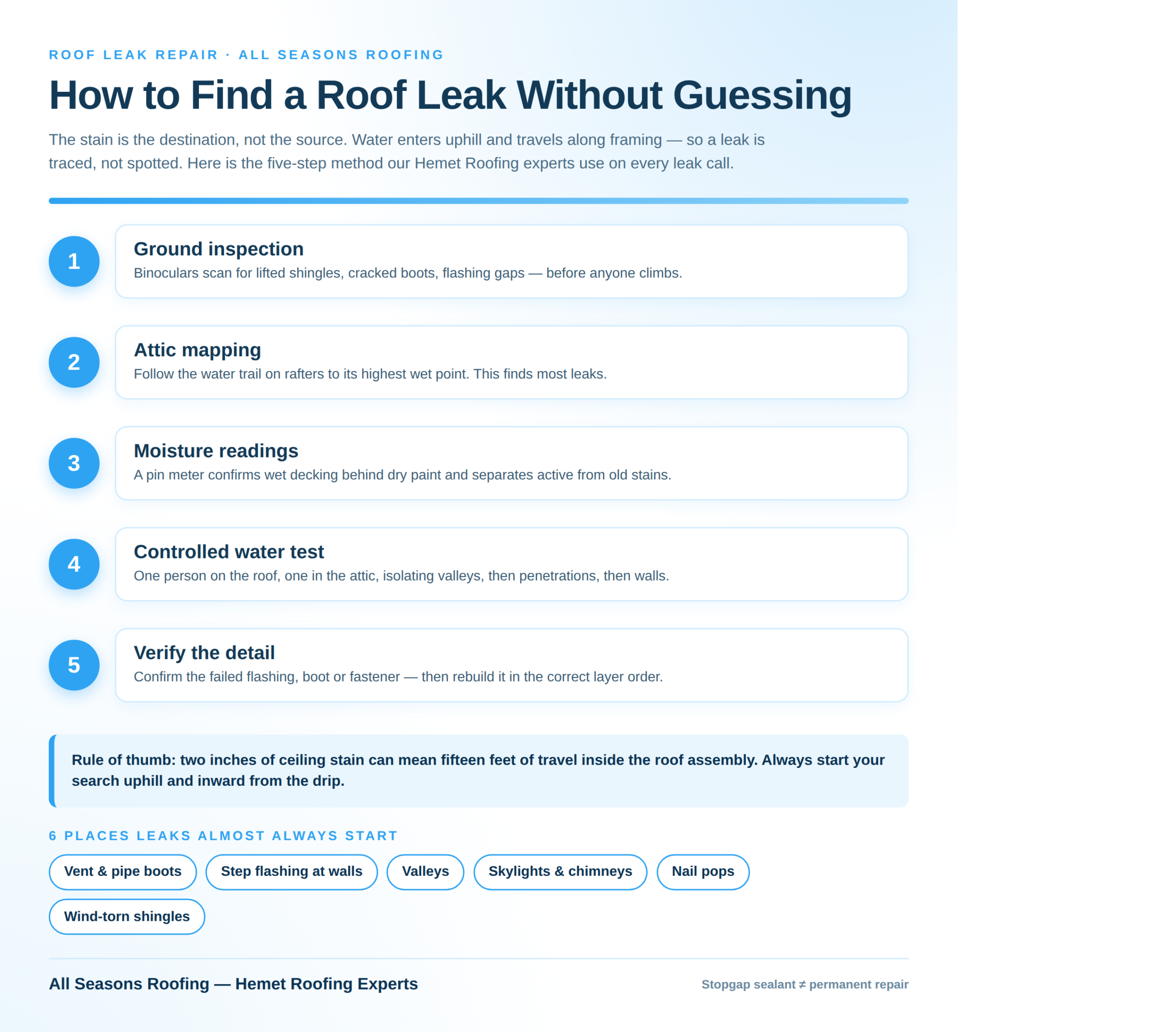
Water is lazy and patient. It enters at a defect, runs down the underside of a shingle, along a rafter, or across the sheathing until something stops it — a nail, a joint, a low spot. Only then does it drip. Two inches of ceiling stain can mean fifteen feet of travel inside the roof assembly, which is why “patch above the stain” almost never works. Our Hemet Roofing experts start every leak call by asking which way the water runs and where the nearest penetration or wall junction sits, then working uphill from there.
5-Step Leak Detection: What a Roofer Actually Does
- Ground inspection. Binoculars across the roof for lifted shingles, missing pieces, cracked boots, and flashing gaps — before anyone climbs.
- Attic mapping. Follow the water trail on rafters and sheathing back to its highest wet point. This step locates most leaks.
- Moisture readings. A pin meter confirms wet decking behind dry paint and separates an active leak from an old stain.
- Controlled water test. One person on the roof, one in the attic, isolating valleys first, then penetrations, then walls.
- Verification. Confirm the failed detail visually — and with thermal imaging after the fact — before any repair is quoted.
6 Places Roof Leaks Actually Start
1. Vent and pipe boots. The rubber collar dries out and cracks in Hemet heat — the most common leak source on residential roofs.
2. Step flashing at walls. Where a roof meets a wall or dormer, flashing must be layered under each shingle course. One installed wrong, or nailed through, leaks.
3. Valleys. Two planes funnel water into one channel; debris, worn metal, or a single nail placed in the valley stops it.
4. Skylights and chimney curbs. Curb flashing and counterflashing fail from expansion — and from caulk used where metal belongs.
5. Nail pops and exposed fasteners. Backed-out fasteners leave holes water walks straight through.
6. Wind-damaged shingles. After a Santa Ana event, any lifted tab is an open door — see our guide to seasonal maintenance for the after-storm checklist.
Stopgap vs. Permanent Repair
When water is coming in tonight, a tarp or a bead of roofing sealant protects the interior until a crew arrives. That is legitimate — as a stopgap with an expiry date. What is not legitimate is calling it done. In Hemet heat, mastic on a cracked boot dries, shrinks, and opens again within one summer, so the leak returns at the worst possible moment: the first monsoon storm of the year.
Permanent repair means removing the failed material down to sound decking and rebuilding the detail in the correct order — underlayment, flashing, shingle in shingle, then counterflashing or boot. Ask which of those layers a contractor intends to replace; a quote that says only “seal the leak” is a stopgap sold as a fix.
How All Seasons Roofing Fixes a Leak
Our Hemet Roofing experts use the same four-step sequence every time: locate the source and photograph it; quote the repair and the replacement alternative side by side; replace the failed detail — new boot, new flashing, new underlayment as needed — and check nearby areas for the same defect; then verify with a water test before cleanup and photograph the finished work.
That process matters because a leak is a symptom. If a 12-year-old roof has one cracked boot and healthy shingles, the honest answer is a small repair. If three penetrations and a valley are failing at once, the honest answer may be that the roof is at the end of its service life — and you deserve to hear that with photos, not adjectives.
Prevention Tips That Keep Leaks From Coming Back
- Look up after every storm. Ten minutes with binoculars catches lifted tabs before the next storm finds them.
- Clear valleys and gutters twice a year. Debris dams are the number one cause of valley leaks.
- Trim branches back six feet. Fewer leaves means fewer dams; less abrasion means fewer cracked shingles.
- Re-flash, don’t re-caulk. When a boot or curb fails, replace the flashing rather than sealing over it.
- Book an inspection before monsoon season. Getting on a calendar in May is easier than getting a tarp in July.
Frequently Asked Questions
How do I find a roof leak without climbing on the roof?
Start in the attic during or right after rain and trace the wet trail upward to its highest point. From the ground, use binoculars to check boots, valleys, and wall junctions on the slope above the stain.
Can a roof leak fix itself?
No. Heat can temporarily soften and reseal an asphalt tab, which is why some leaks seem to disappear — but the failed flashing or fastener is still there and will leak again.
Does homeowners insurance cover roof leaks?
Policies typically cover sudden damage from a storm event, not long-term deterioration or lack of maintenance. Date-stamped photos and a written inspection report are what support a claim.
Bottom line: a leak is a diagnostic problem before it is a repair problem. Trace the water, rebuild the failed detail, verify it with a test — then fix the conditions that caused it. If you are seeing stains, granules in the gutters, or daylight in the attic, have All Seasons Roofing look at it before the next storm decides for you.