
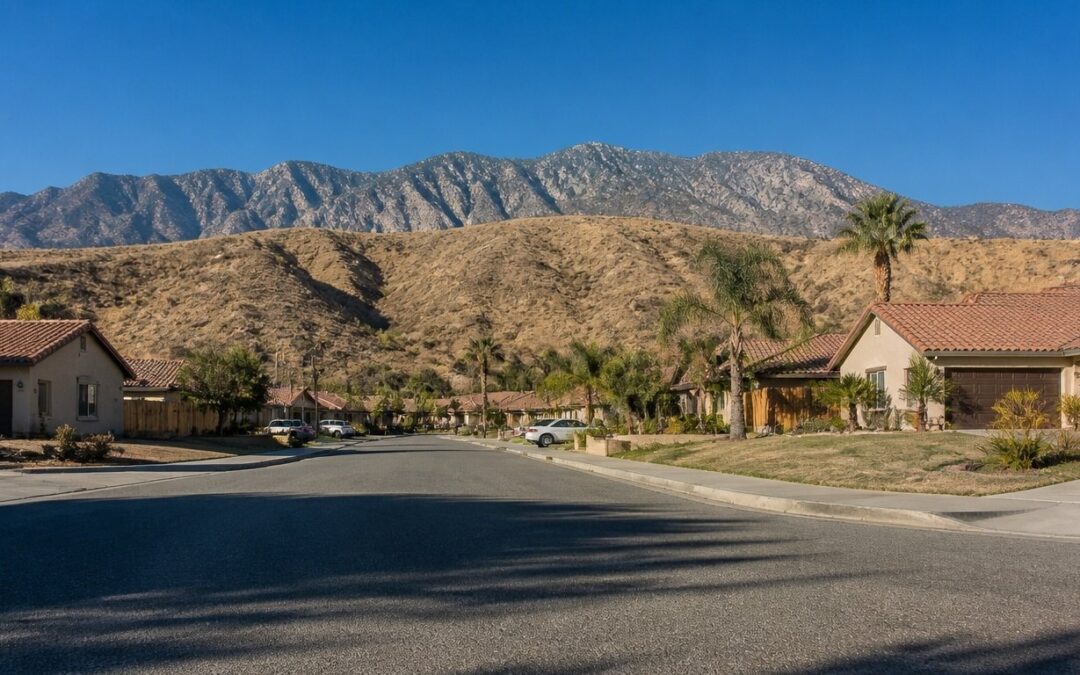
A Hemet roof should be inspected twice a year — in spring before the heat arrives and in fall before the Santa Ana winds — plus after any major wind or monsoon storm. That schedule is not marketing filler. In the San Jacinto Valley, roofs face summer highs above 100°F, months of hard UV, gusting Santa Ana winds and short, heavy monsoon downpours.
At All Seasons Roofing, our Hemet roofing experts are most often called out for problems that began months earlier: a lifted shingle, a clogged valley, a cracked bead of sealant. This is the routine we recommend across Hemet and the San Jacinto Valley.
Key Takeaways
- Hemet’s heat, wind and monsoon cycle attacks roofs differently than the coast, so seasonal checks matter more than one annual look.
- Spring and fall are the two inspections that catch most failures before they reach your ceiling.
- Most leaks begin at flashing, valleys and penetrations — not in the middle of the roof field.
- Granule loss, lifted edges and cracked tiles are cheap warnings now and expensive repairs later.
- Our Hemet roofing experts recommend a professional inspection before buying a home and after any wind event above 40 mph.
Table of Contents
- Why Hemet Roofs Age Faster Than Coastal Roofs
- Spring (March–May): Inspect Before the Heat Arrives
- Summer (June–September): Heat Stress and Monsoon Rain
- Fall (October–November): Secure the Roof Before Santa Ana Winds
- Winter (December–February): Rain Season Leak Watch
- The Hemet Roof Maintenance Calendar at a Glance
- What Deferred Maintenance Actually Costs
- What You Can Check Safely — and What You Should Not
- Frequently Asked Questions
Why Hemet Roofs Age Faster Than Coastal Roofs
Roofing guidance written for Los Angeles or San Diego assumes mild summers and steady coastal humidity. Hemet runs a different program. Summer afternoons regularly pass 100°F, and attic air climbs far higher, baking the oils out of asphalt sealant and drying tile underlayment from underneath. Winter brings fast, intense rain rather than slow drizzle. Spring and fall bring Santa Ana winds that peel back edges and break fasteners.
The result is a roof that fails from the details outward: sealant first, then flashing, then the field. Our Hemet roofing experts recommend inspecting those details on a schedule rather than waiting for a ceiling stain — by then water has usually been traveling for weeks.
Spring (March–May): Inspect Before the Heat Arrives
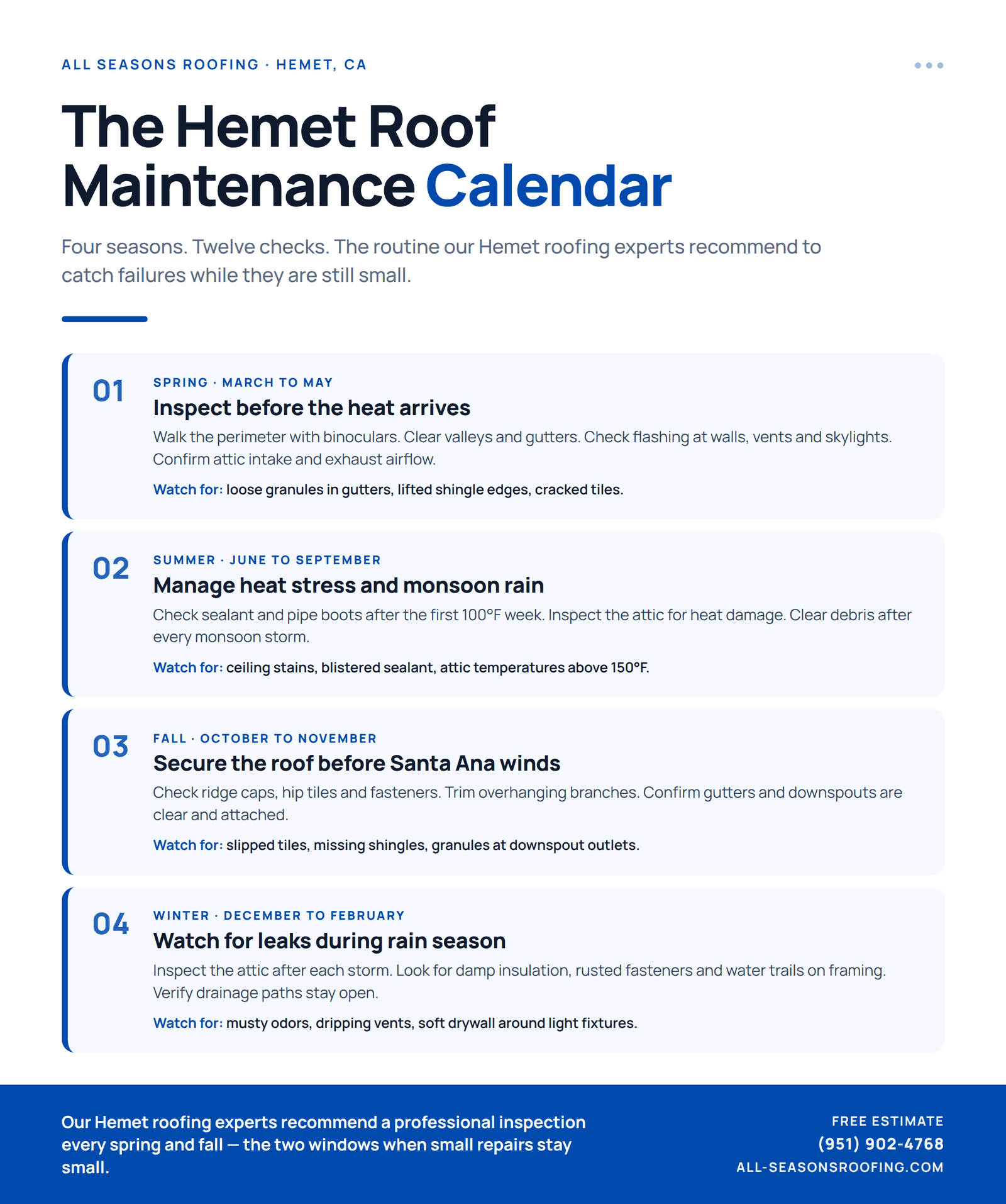
Spring is the highest-value inspection of the year. Damage caught now gets repaired in mild weather, before heat makes new sealant fail and before crews book out for summer.
- Walk the perimeter with binoculars and look for lifted shingle edges, cracked tiles and rusted or missing flashing.
- Clear leaves and grit from valleys, gutters and downspout strainers.
- Check pipe boots, skylight curbs and wall terminations, where sealant dries out first.
- Confirm attic intake and exhaust vents are open and unobstructed.
Our Hemet roofing experts recommend booking this inspection in March or April. A failed pipe boot caught in spring is a small repair; caught in August, it usually means stained ceilings and replaced insulation too.
Summer (June–September): Heat Stress and Monsoon Rain
Summer takes the most abuse and gets the least attention — nobody wants to be on a roof in 105°F. Heat softens sealant, expands materials and cracks them as evenings cool, and attic air above 150°F shortens shingle life from below. Monsoon storms then arrive fast and leave standing water in any low spot or clogged valley.
- Look for blistered sealant and dried, cracked caulk lines after the first long heat wave.
- Check the attic for heat damage, discolored decking and brittle wiring insulation.
- Clear debris after every storm, especially where two roof planes meet.
Fall (October–November): Secure the Roof Before Santa Ana Winds
Santa Ana winds are the most underrated roofing risk in the valley. They lift edge metal, work ridge caps loose, tear shingles at the corners and drive rain sideways into places gravity would never take it.
- Check ridge caps, hip tiles and perimeter fasteners for movement.
- Remove debris that could become a projectile in high wind.
- Verify gutters are firmly attached and downspouts discharge away from the foundation.
- Inspect again after any wind event strong enough to move patio furniture.
Our Hemet roofing experts recommend this inspection every October — before the first wind advisory of the season, not after it.
Winter (December–February): Rain Season Leak Watch
Winter is inspection season, not repair season: leaks are easier to trace wet, but permanent repairs need dry surfaces.
- Check the attic after each storm for damp insulation, water trails on framing and rusted fasteners.
- Watch for musty odors, dripping vent fans and soft drywall around light fixtures.
- Confirm water still exits the roof where it should: valleys, scuppers, drains and downspouts.
The Hemet Roof Maintenance Calendar at a Glance
| Season | Main focus | Key checks | Warning sign |
|---|---|---|---|
| Spring | Pre-summer inspection | Valleys, flashing, boots, attic airflow | Granules in gutters, lifted edges |
| Summer | Heat and monsoon | Sealant, attic heat, post-storm debris | Ceiling stains, blistered caulk |
| Fall | Wind preparation | Ridge caps, fasteners, gutters, branches | Slipped tiles, missing shingles |
| Winter | Leak monitoring | Attic moisture, drainage, interior ceilings | Damp insulation, musty smell |
What Deferred Maintenance Actually Costs
Roof damage compounds predictably: debris traps water, water sits against underlayment, underlayment fails, moisture reaches decking, and decking rots. Each step costs more than the last.
What You Can Check Safely — and What You Should Not
Ground-level checks are safe and useful: binoculars, gutters you can reach from a stable ladder, and the underside of your ceiling. Walking a roof is different. Tile cracks under a misplaced foot, shingles soften in heat, and a fall from a single-story roof is still serious. Our Hemet roofing experts recommend leaving roof-level inspection to a licensed C-39 roofer and asking for photos of anything flagged.
Frequently Asked Questions
How often should a roof in Hemet be inspected?
Twice a year — spring and fall — plus after any storm with high wind or heavy rain. Roofs over 15 years old benefit from an additional mid-summer look at flashing and sealant.
Is granule loss on shingles normal in Hemet?
Some shedding is normal in year one. Steady accumulation after year five usually means the shingle is aging faster than its rated life — common in high-heat inland climates.
Can I pressure wash my roof?
No. It strips granules, can crack tile and may void the warranty. Use low-pressure rinsing or a soft wash.
How long does a roof last in Hemet?
Asphalt shingles typically last 18 to 25 years here, less on unventilated roofs. Concrete tile can serve 40 to 50 years or more, but the underlayment beneath it usually needs replacement at 20 to 30 years.
Ready to get ahead of the season? All Seasons Roofing offers free estimates across Hemet and the San Jacinto Valley. Call (951) 902-4768 to schedule an inspection with a licensed, insured C-39 contractor.