

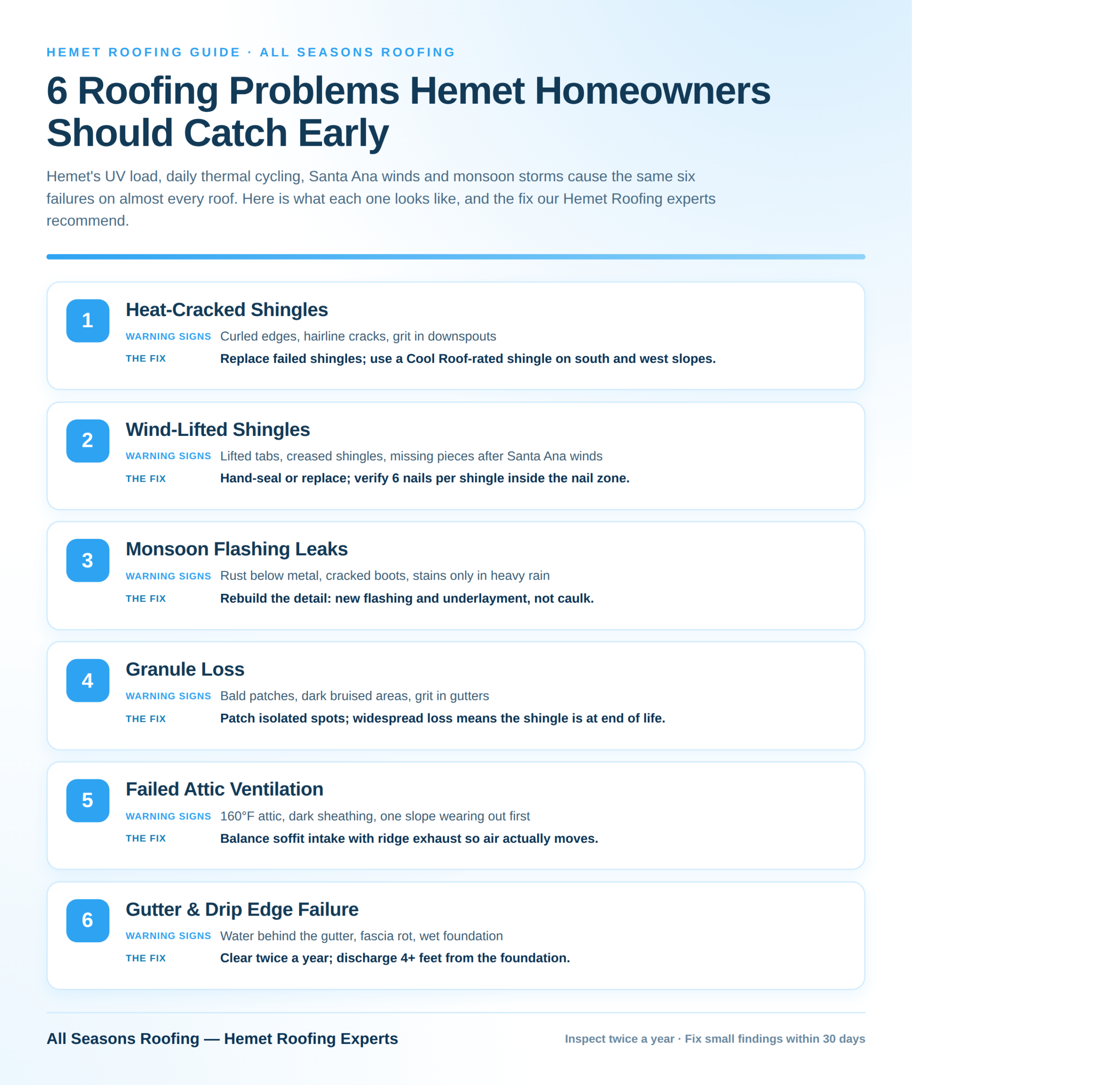
The six most common roofing problems in Hemet are heat-cracked shingles, wind-lifted or missing shingles, monsoon leaks around flashing and valleys, granule loss from UV aging, attic ventilation that fails in extreme heat, and gutters or drip edge that push water into the fascia. Each starts as a small, inexpensive repair. Left through another Hemet summer, each becomes decking rot, a stained ceiling, or a full replacement. Our Hemet Roofing experts at All Seasons Roofing see all six every week across Hemet, San Jacinto, and the rest of the San Jacinto Valley — and the pattern is always the same: the roof warned the homeowner months earlier.
Key Takeaways
- Heat is Hemet’s number one roof killer. UV exposure plus daily thermal cycling cracks and embrittles shingles years before their rated lifespan ends.
- Leaks rarely start where the stain appears. Water travels along decking, so a ceiling spot is often several feet from the real entry point.
- Flashing and valleys cause more leaks than shingles do. Our Hemet Roofing experts inspect every wall junction, penetration, and valley first.
- Ventilation is a roofing problem, not just an energy problem. A superheated attic cooks shingles from below and can void manufacturer warranties.
- Small repairs stay small only if you act. Inspect after every monsoon season and Santa Ana wind event, and fix findings within 30 days.
- Never seal a leak and call it fixed. Sealant is a stopgap; the permanent fix restores the failed flashing or underlayment.
Table of Contents
- Heat-Cracked, Brittle Shingles
- Wind-Lifted and Missing Shingles
- Monsoon Leaks at Flashing, Valleys, and Penetrations
- Granule Loss and Exposed Fiberglass Mat
- Attic Ventilation That Fails in Extreme Heat
- Clogged Gutters and Failing Drip Edge
- 5 Roofing Tips Our Hemet Experts Recommend
- When to Call All Seasons Roofing
- Frequently Asked Questions
1. Heat-Cracked, Brittle Shingles
Hemet roof surfaces routinely pass 150°F in July, then cool by 60 degrees overnight. Shingles expand and contract through that swing every day, and the asphalt that keeps them flexible slowly cooks away — thermal cracking. Look for curled edges, random cracks mid-slope, and grit at the bottom of downspouts. The fix: replace the failed field shingles, then remove the cause. Our Hemet Roofing experts specify a Cool Roof Rating Council–rated shingle on south- and west-facing slopes, which reflects solar energy instead of absorbing it.
2. Wind-Lifted and Missing Shingles
Santa Ana winds pry at the sealed tabs that hold a shingle roof together, and once a tab lifts, the adhesive strip rarely re-bonds. Look for lifted corners, creased shingles after a wind event, missing pieces on the windward slope, and combed ridge caps. The fix: hand-seal or replace every lifted shingle and confirm six nails per shingle inside the manufacturer’s nailing zone. Misplaced nails are the most common installation defect our Hemet Roofing experts find on roofs under ten years old.
3. Monsoon Leaks at Flashing, Valleys, and Penetrations
Summer monsoon storms can drop a month of rain in an afternoon, and water finds the weakest detail first: step flashing at walls, valley metal, vent boots, skylight curbs, and chimney counterflashing. That is why seasonal roof maintenance matters more here than on the coast. Look for rust streaks below metal, cracked boots, gaps where the roof meets a wall, and stains that appear only in heavy rain. The fix: re-flash the detail with new metal and underlayment. Caulk over a failed boot will not survive one summer of heat.
4. Granule Loss and Exposed Fiberglass Mat
Granules are the shingle’s UV armor. When they wash away, sunlight attacks the asphalt, then the fiberglass mat beneath it. Look for bald patches, dark bruised areas, and heavy grit in gutters after rain. Isolated spots can be patched, but widespread granule loss means the shingle is at end of life — no coating restores granules that are already gone.
5. Attic Ventilation That Fails in Extreme Heat
An unventilated Hemet attic can reach 160°F, baking the sheathing and the shingles above it. In winter, the same attic traps moisture that condenses on nails and plywood. Look for an attic you cannot stand in, dark or delaminating sheathing, rusted nail tips, and one slope wearing out before the others. The fix: balance soffit intake with ridge or roof exhaust so air actually moves — exhaust without intake just pulls conditioned air out of the house.
6. Clogged Gutters and Failing Drip Edge
Granule-filled gutters overflow at the fascia, rot the wood behind them, and dump water at the foundation. Look for sagging gutters, water running behind the gutter instead of into it, peeling fascia paint, and drip edge pulled away from the rake. Clear gutters twice a year, discharge downspouts at least four feet from the foundation, and re-secure separated drip edge.
5 Roofing Tips Our Hemet Experts Recommend
- Inspect from the ground twice a year — in spring and after the last monsoon — with binoculars. You can spot curling, missing shingles, and flashing gaps without stepping on the roof.
- Photograph everything with a date. Photos of a small problem become evidence for an insurance claim or a warranty call six months later.
- Keep branches six feet off the roof. They abrade shingles in wind and fill valleys with debris that holds moisture.
- Never walk the roof in summer heat. Shingles soften, and granule damage from foot traffic is permanent.
- Fix findings within 30 days. Our Hemet Roofing experts would rather repair two shingles than sell a replacement — which is why every inspection we do includes photos of what we found.
When to Call All Seasons Roofing
Call a professional when you see sagging, stains that grow after every rain, granules across an entire slope, daylight in the attic, or a leak you cannot trace within 20 minutes. All Seasons Roofing inspects and repairs roofs throughout Hemet and the San Jacinto Valley, and we document conditions with photos so you can choose between repair and replacement with real information. Comparing bids already? Read our guide on choosing a roofing contractor in Hemet before you sign.
Frequently Asked Questions
How often should a Hemet roof be inspected?
Twice a year — spring and early fall — plus after any wind event strong enough to move patio furniture. Heat and wind, not rain, are what age a Hemet roof fastest.
How long does an asphalt shingle roof last in Hemet?
Most 25- to 30-year shingles deliver roughly 15 to 20 years here because of UV exposure and daily thermal cycling. Attic ventilation and slope orientation move that number.
Is a roof leak an emergency?
It is if water is reaching a ceiling or a light fixture. Shut off power to affected rooms, tarp the area, and call for same-day service. A leak with no interior damage can usually wait for a scheduled inspection.
Bottom line: every problem in this guide announces itself long before it gets expensive. Our Hemet Roofing experts at All Seasons Roofing recommend a ground-level inspection twice a year and a professional inspection whenever a storm passes through — that routine is the cheapest roof insurance available.