
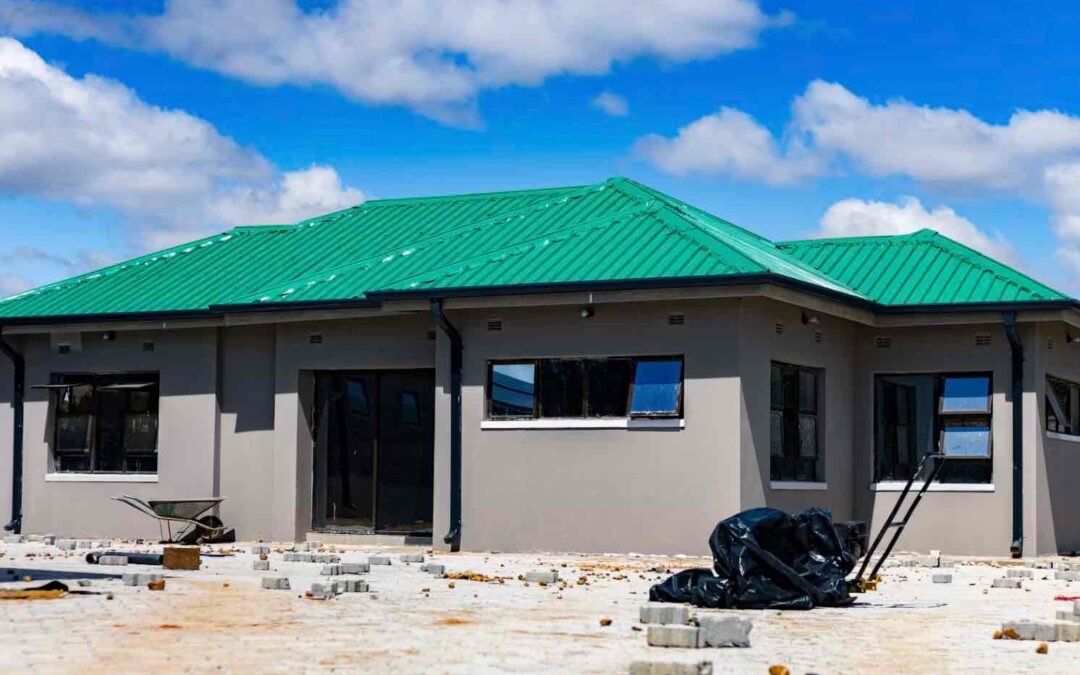
A professional roof replacement generates thousands of pounds of falling debris, hundreds of nails, and days of heavy equipment traffic around your home. Protecting what sits below the roofline is not an afterthought — it is a documented part of the job. All Seasons Roofing, a Hemet roofing company serving the San Jacinto Valley, builds site protection into every estimate and every work day.
Key Takeaways
- A qualified crew performs a pre-job walkthrough documenting the condition of landscaping, hardscape, gutters, windows, and stored items before any material arrives.
- Tarps, plywood sheeting, and padded barriers are the primary defenses for plants, AC units, pool equipment, and patio surfaces.
- Driveways are protected with plywood runners or wood blocking under dumpster wheels and equipment legs — asphalt in Hemet summer heat is especially vulnerable to indentation.
- Gutters are shielded with standoff bracing and gutter guards during tear-off; experienced crews never rest ladders directly on gutter runs.
- Windows and screens are covered or removed; glass is most at risk from ricocheting debris during tear-off, not from falling shingles.
- Magnetic nail sweeps should be performed at least twice daily and again at final cleanup — nails are the single most common post-job complaint in roofing.
- All Seasons Roofing documents protection with before-and-after photos and carries full liability coverage, so homeowners in Hemet are protected if something is damaged despite precautions.
Table of Contents
- Why Site Protection Matters More Than Homeowners Expect
- The Pre-Job Walkthrough
- Protecting Landscaping, Plants, and Irrigation
- Protecting Driveways, Walkways, and Hardscape
- Protecting Gutters and Downspouts
- Protecting Windows, Screens, and Siding
- Protecting Outdoor Belongings, Pools, and HVAC
- Debris Control and Nail Removal
- What Homeowners Should Do Before the Crew Arrives
- Questions to Ask Any Hemet Roofing Contractor
- Frequently Asked Questions
- Why Hemet Homeowners Choose All Seasons Roofing
Why Site Protection Matters More Than Homeowners Expect
A typical 2,000 square foot tear-off removes roughly four to six tons of old roofing material. That material comes off fast, falls hard, and does not land gently. Add to it:
- Loose nails scattered across the perimeter — often 10,000 or more on a full replacement
- Ladders, scaffolding, and a dumpster parked on your property for several days
- Foot traffic by a crew carrying bundles weighing 70 to 80 pounds each
- Wind — a constant factor in the San Jacinto Valley — redistributing debris far beyond the drip edge
In Hemet specifically, local conditions raise the stakes. Summer surface temperatures soften asphalt driveways, making them prone to permanent indentation from dumpster wheels. Drought-tolerant and xeriscape landscaping common in the Inland Empire — decomposed granite, succulents, decorative rock — shows damage and debris contamination immediately and is costly to restore.
And many Hemet homes have mature desert landscaping or citrus that cannot simply be replaced in a season.This is why All Seasons Roofing treats protection as a line item, not a courtesy.
The Pre-Job Walkthrough
Before a single bundle is delivered, a crew lead should walk the property with you and document:
| Item | What Gets Recorded |
|---|---|
| Landscaping | Existing plant health, bed edges, irrigation head locations |
| Hardscape | Pre-existing driveway cracks, stains, paver settling |
| Gutters | Current condition, sag points, attachment integrity |
| Windows & screens | Existing chips, cracked screens, seal condition |
| Exterior items | Furniture, grills, planters, decor, pet structures |
| Mechanical | AC condenser, pool equipment, solar, satellite dish |
| Access | Dumpster placement, material staging, crew parking |
Photographing pre-existing conditions protects both parties. It prevents disputes and establishes exactly what the crew is responsible for returning to original condition. All Seasons Roofing performs this walkthrough on every Hemet project and shares the photo record with the homeowner.
Protecting Landscaping, Plants, and Irrigation
Heavy-duty tarps are laid over planting beds extending well beyond the roofline — debris travels farther than homeowners expect, particularly on steeper pitches.
Plywood tenting is built over shrubs, small trees, and specimen plants. A simple tarp laid directly on a plant transfers impact force; a plywood A-frame deflects it.
Soft-tie bundling gathers branches of larger shrubs away from the work zone without breaking them. Crews should never crush or stake over plants.
Irrigation protection matters in Hemet. Pop-up sprinkler heads and drip emitters along the foundation line sit directly in the debris zone. Heads are flagged, and crews avoid driving wheelbarrows or staging material over drip lines.
Avoiding soil compaction — material is staged on plywood or in the driveway, not on lawn or planting beds.Post-job restoration — beds are raked, decomposed granite and rock are blown clean, and debris is removed by hand from gravel landscaping, where blowers alone are insufficient.
Protecting Driveways, Walkways, and Hardscape
The driveway takes the most concentrated abuse of any surface on the property.Dumpster protection. Wood blocking or plywood sheets go under every wheel and under the rear roller bar. On asphalt during Hemet’s hot months, this is non-negotiable — a loaded dumpster will press into softened asphalt within hours.
Plywood runners are laid along wheelbarrow and foot traffic paths across pavers, stamped concrete, and decorative surfaces.
Ladder footing. Rubber-footed ladders and protective pads prevent scratching and point-load chipping on concrete and tile.
Tar and sealant control. Drop cloths go under any area where hot-applied material, sealants, or adhesives are used. Asphalt staining on concrete is extremely difficult to remove.
Dumpster placement alternatives. When a driveway is new, decorative, or especially vulnerable, All Seasons Roofing can place the dumpster at the curb or use a dump-trailer setup instead — discussed during the estimate, not improvised on day one.
Protecting Gutters and Downspouts
Gutters are the most commonly damaged component during a roof replacement, and the damage is usually avoidable.Ladder standoffs hold ladders off the gutter face entirely, transferring load to the fascia or wall. A ladder resting on a gutter will dent or detach it.
Gutter covers — temporary guards, foam inserts, or tarping — prevent granules, nails, and shredded felt from washing into the system and clogging downspouts.
Controlled tear-off direction. Debris is directed away from gutter runs toward tarped ground zones or a dumpster chute rather than raked over the edge.
Post-job gutter flush. A thorough crew clears gutters and downspouts of granules and debris before final walkthrough. Clogged downspouts after a roof job cause overflow at the first rain — a real concern during Southern California’s winter storm season.
Detach-and-reset. On some Hemet homes, particularly with older or fragile gutter systems, the cleanest approach is removing gutters before tear-off and reinstalling after. All Seasons Roofing will recommend this when conditions warrant.
Protecting Windows, Screens, and Siding
Screen removal. Screens are removed, labeled, stacked in a safe location, and reinstalled at completion. Screens are easily torn by ricocheting debris and are the most frequently damaged item after gutters.
Window covering. Plywood or heavy tarping protects windows directly below steep slopes, dormers, and valleys where debris velocity is highest. Skylights and glass doors receive the same treatment.
Wall and siding protection. Tarps hung from the eave line shield stucco, siding, and trim from scuffing and impact — relevant on the stucco exteriors common throughout Hemet.
Exterior fixture protection. Light fixtures, house numbers, mailboxes, and doorbell cameras near the roofline are covered or temporarily removed.
Protecting Outdoor Belongings, Pools, and HVAC
Relocation first. Patio furniture, grills, planters, decor, and children’s play equipment are moved out of the work zone entirely when possible — relocation always beats covering.Covering second. Items too heavy to move — built-in BBQ islands, pergolas, fixed seating — are tarped and padded.
Pool protection. Pools are covered or, at minimum, the adjacent deck and water surface nearest the structure are tarped. Granules and nails in a pool mean filter damage and a service call. Pool equipment pads receive plywood covers.
HVAC condensers. Units are covered to keep debris out of coils and fins.
Crews avoid setting material or standing on condenser cabinets.
Solar arrays. Panels require coordination and, depending on scope, a solar contractor for removal and reset. All Seasons Roofing identifies this at estimate stage so it is scheduled, not discovered mid-project.
Garage and attic. Vibration from tear-off dislodges decades of dust in attics and garages. Covering stored items in the garage and anything beneath open attic framing is a step many homeowners appreciate being warned about.
Debris Control and Nail Removal
Catch systems. Tarps, debris chutes, and ground catch zones keep material contained rather than scattered.
Daily cleanup. A professional crew leaves the site broom-clean each evening, not just at project end.
Magnetic sweeps. A rolling magnet is run across the driveway, walkways, lawn, and perimeter — minimum twice daily and again at final cleanup. All Seasons Roofing performs multiple passes in different directions, because a single pass misses nails lying in certain orientations.
Hand-picking gravel and planting beds. Magnets do not recover nails in decorative rock or decomposed granite. Those areas require hand inspection, which is exactly where cut-rate crews stop short.Final walkthrough. The crew lead walks the property with you, compares against pre-job photos, and confirms every protected item has been restored.
What Homeowners Should Do Before the Crew Arrives
- Move vehicles out of the driveway and garage for the duration
- Relocate potted plants, decor, and light furniture you want personally handled
- Secure pets indoors — nails and open gates are a genuine hazard
- Take down wall hangings and shelf items inside; tear-off vibration shakes walls
- Cover stored items in the garage and attic
- Point out irrigation heads, low-voltage lighting, buried lines, and septic locations
- Notify immediate neighbors of the schedule
All Seasons Roofing provides a written prep checklist to every Hemet homeowner ahead of the start date.
Questions to Ask Any Hemet Roofing Contractor
- Is site protection described in writing in the contract?
- Will you photograph pre-existing conditions?
- How will you protect my driveway from the dumpster?
- Will ladders contact my gutters?
- How many magnetic sweeps per day?
- Who is liable if landscaping or hardscape is damaged?
- Are you licensed with the CSLB and carrying current liability and workers’ compensation coverage?
- What does daily cleanup include?
A contractor who cannot answer these specifically has not thought about your property.
Frequently Asked Questions
Will my plants survive a roof replacement? With proper tarping and plywood tenting, healthy established plants almost always recover. Damage typically results from crushing or prolonged covering in heat — which is why tarps come off at the end of each work day during Hemet summers.
Can the dumpster crack my driveway? A dumpster placed without blocking can indent asphalt and, on older concrete with existing stress cracks, worsen them. Proper plywood and wood blocking distributes the load and prevents this.
What if a nail damages my tire? A licensed, insured contractor handles it.
All Seasons Roofing carries full liability coverage and resolves any post-job issue directly.
How long does my yard stay covered? Only during active work hours. Tarps are pulled back daily so plants get light and airflow.
Do you move my patio furniture back? Yes. Anything the crew relocates is returned to its original position at final walkthrough.
Should I be home during the project? Not required, but attending the pre-job walkthrough and final walkthrough is strongly recommended.
Why Hemet Homeowners Choose All Seasons Roofing
Roof protection is easy to promise and easy to skip. The difference shows up in a dented gutter, a nail in a tire, or a permanent indentation in a driveway — months after the crew is gone.All Seasons Roofing provides:
- Written site protection plans included in every estimate
- Documented pre-job and post-job photo records
- Full tarping, plywood tenting, and hardscape protection on every project
- Ladder standoffs and gutter protection as standard practice
- Multiple daily magnetic nail sweeps plus hand-clearing of gravel and rock landscaping
- Daily broom-clean site conditions
- Licensed, bonded, and fully insured service throughout Hemet, San Jacinto, Menifee, Winchester, Temecula, and the surrounding Inland Empire
- A homeowner prep checklist delivered before the start date
Your roof is the project. Your property is the promise.
Contact All Seasons Roofing, your local Hemet roofing company, for a free inspection and a written estimate that spells out exactly how your home will be protected.